Never Waste a Good Idea.
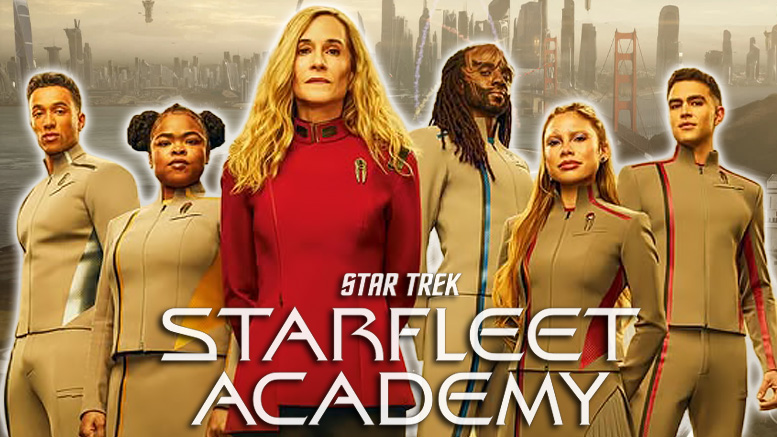
Kris and I have been enjoying Paramount’s “Star Trek: Starfleet Academy”. The one complaint I have with it, and other streaming shows, is that a season is only ten episodes long. You get into a show, like, “Star Trek: Strange New Worlds”, you love it, you love the characters and then it’s over in ten episodes. And then you might have to wait two years for the next season.
But “Star Trek: Starfleet Academy” has some interesting concepts, one of which it’s continuing from its predecessor, “Star Trek: Discovery.” In short, the timeline of Discovery and Academy takes place about a thousand years after the timeline of Next Generation. Near the end of that time, there was “The Burn”, an event that destroyed all dilithium crystals, making warp drive impossible. And without warp drive, the United Federation of Planets fell apart. So, a driving force behind Discovery and Academy is to reunite the Federation of Planets. We see this in the second episode where Starfleet is trying to get the Betazoids to rejoin.
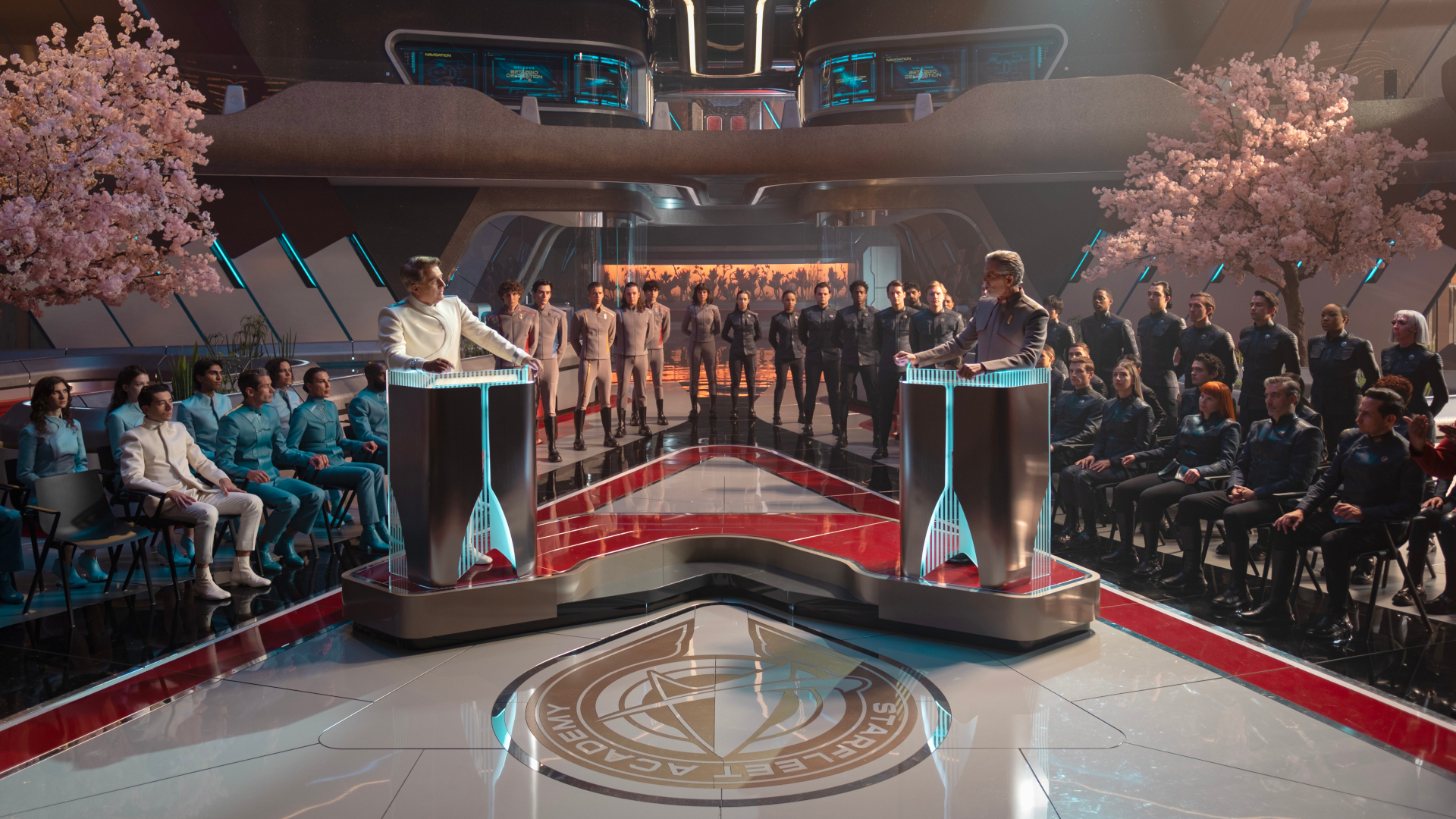
Interesting idea, I wonder how they came up with that?
Oh, wait, I think I can trace it.
But to do so, you have to be more that just a Start Trek fan, you have to be a Gene Roddenberry fan.
Back on October 2, 2000, Gene Roddenberry’s “Andromeda” premiered. It was based on Roddenberry’s work before he died, and it had a similar premise. From Wikipedia https://en.wikipedia.org/wiki/Andromeda_(TV_series)
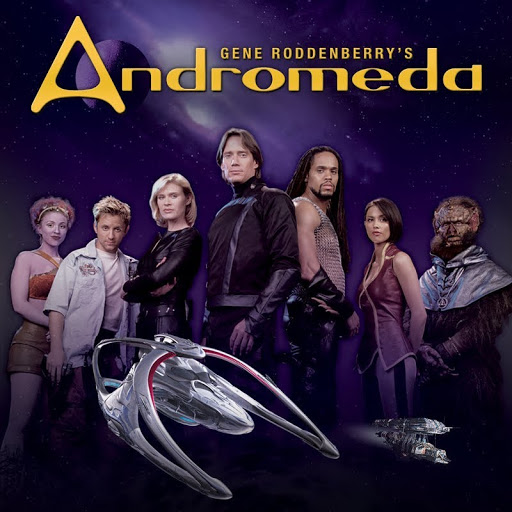 Dylan Hunt is the captain of the Commonwealth starship Andromeda Ascendant. During the attack, Dylan’s Nietzschean first officer, Gaheris Rhade, betrays Dylan and attempts to kill him. Dylan kills Gaheris as Andromeda is caught at the edge of the event horizon of a black hole, freezing both (Dylan Hunt and his ship) in time.
303 years later, in CY 10087 (approx 5167 AD), the Andromeda is pulled from the event horizon by the crew of the salvage ship Eureka Maru… The Systems Commonwealth has fallen, and the era known as The Long Night has begun. Hunt recruits the crew to join him in restoring the Systems Commonwealth and to, “rekindle the light of civilization“.
But wait, even this sounds familiar. Back in 1973…
Genesis II is a 1973 American made-for-television science fiction film[1] created and produced by Gene Roddenberry[2] and directed by John Llewellyn Moxey.[3] The film, which opens with the line “My name is Dylan Hunt. My story begins the day on which I died.”, is the story of a 20th-century man thrown forward in time, to a post-apocalyptic future, by an accident in suspended animation. The film stars Alex Cord, Mariette Hartley, Ted Cassidy, Percy Rodrigues, Harvey Jason, Titos Vandis, Bill Striglos, Lynne Marta, Harry Raybould and Majel Barrett.[4]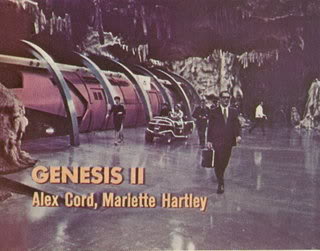
Hunt is accidentally found and rescued by an organization calling themselves, “PAX” (the Latin word for “peace”). PAX members are the descendants of the NASA personnel who worked and lived at the Carlsbad installation in Dylan’s time. They are explorers and scientists who preserve what little information and technology survived from before the conflict, and who seek to learn and acquire more in an effort to build a new civilization.
https://en.wikipedia.org/wiki/Genesis_II_(film)
Genesis II was actually piloted three times, but never picked up. You can watch the original pilot here https://www.youtube.com/watch?v=rsVOhh9BqeQ
But the lesson here, never throw away a good idea.
Dennis
306th blog completed.
Second Steampunk novel: 17,748 words. Chapter Five done.
Second Steampunk screenplay: 157 pages.
First Steampunk screenplay: Updated with notes from the novelization.
First Steampunk novel: 77,546 words. Completed until an editor reviews it.
Third Steampunk screenplay: 38 pages.
By the way, Data of “Star Trek: The Next Generation”, can trace his roots back to “The Questor Tapes” also by Gene Roddenberry. https://en.wikipedia.org/wiki/The_Questor_Tapes
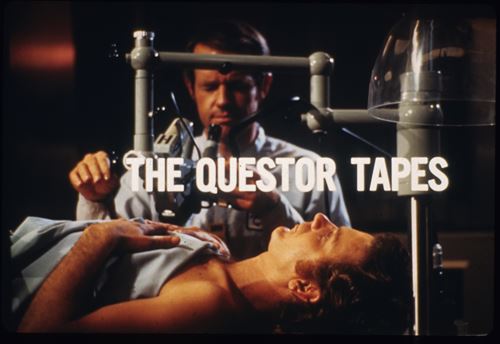 The Questor Tapes is a 1974 American made-for-television sci-fi drama film about an android (portrayed by Robert Foxworth) with incomplete memory tapes who is searching for his creator and his purpose. Conceived by Gene Roddenberry, who is credited as executive consultant, the script is credited to Roddenberry and fellow Star Trek alumnus Gene L. Coon.[1] The pilot was directed by Richard Colla.[2]
A novelization, written by D. C. Fontana[3] (another Star Trek alumnus), was dedicated to Coon, who died before the program was broadcast.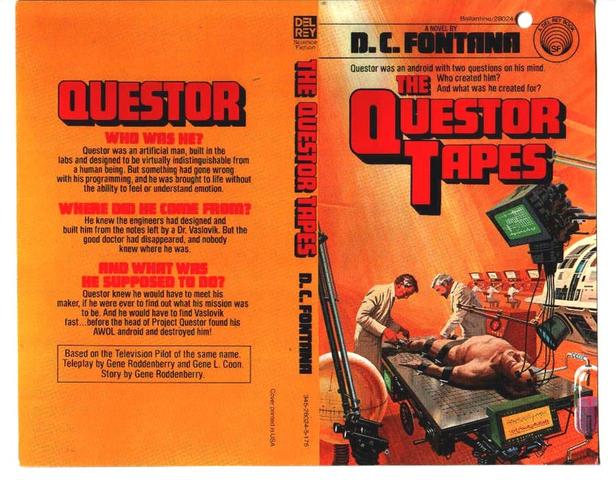
Leave a Reply